
Compostable packaging in Vietnam: what EN 13432 requires and how CompoFlex is tested
Short answer. CompoFlex is a compostable packaging material made in Vietnam by GPS PLAS, a TURN GREEN member. It is EN 13432 compliant. In TÜV Rheinland testing it passed ISO 14855-1 in 144 days, well inside the 180 days EN 13432 allows. CompoFlex bags also hold the Vietnam Ecolabel under Decision 2032/QĐ-BNNMT, certificate code VN-ECO-2026-004.
Retail buyers in Vietnam hear three words used as if they meant the same thing: "tự hủy", biodegradable and compostable. They do not. Getting this wrong is how a supermarket ends up printing an eco claim on a bag that breaks into fragments. This guide sets out the differences, what EN 13432 checks, and the evidence behind CompoFlex.
Compostable, biodegradable and "self-destructing" bags are different things
"Túi tự hủy" (oxo-degradable bags). These are ordinary PE bags with an additive that makes them crumble under heat and light. They fragment into small pieces of plastic. Fragmenting is not biodegradation, and the EU Single-Use Plastics Directive (2019/904) bans oxo-degradable plastics for that reason.
Biodegradable. Microorganisms turn the material into carbon dioxide, water and biomass. A standard test measures how much and how fast. The word says nothing on its own about time or setting, so always ask which standard and how many days.
Compostable. A stricter claim. The material must biodegrade within a fixed time in composting conditions, break down physically, and leave compost that is safe for plants. EN 13432 is the European reference for packaging, and it is the one most Vietnamese buyers and exporters ask about.
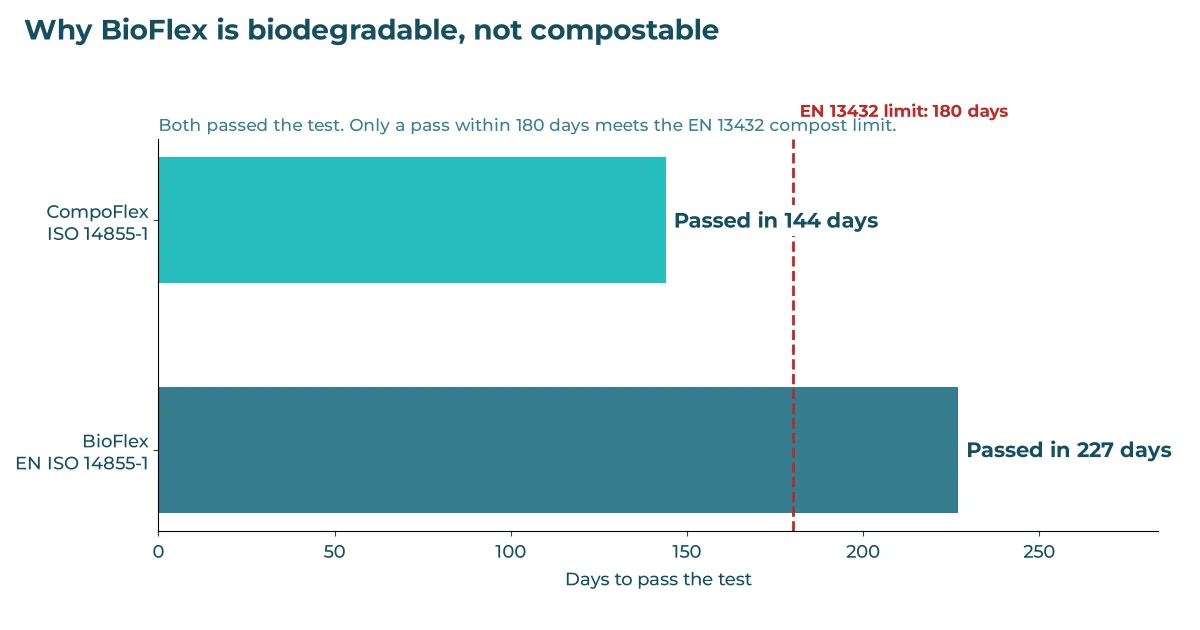
A good example of the gap is our own range. BioFlex passed EN ISO 14855-1 in 227 days. That makes it biodegradable, but 227 days is past the EN 13432 limit, so we never call it compostable. CompoFlex passed in 144 days.
What EN 13432 checks, and what a biodegradation test alone proves
EN 13432 has four parts:
- Characterisation: volatile solids, heavy metals and fluorine below set limits.
- Biodegradation: a pass in the biodegradation test within 180 days in controlled composting, usually measured with ISO 14855-1.
- Disintegration: after 12 weeks of composting, no more than 10% of the material may remain on a 2 mm sieve.
- Compost quality and ecotoxicity: the finished compost must not harm plant growth.
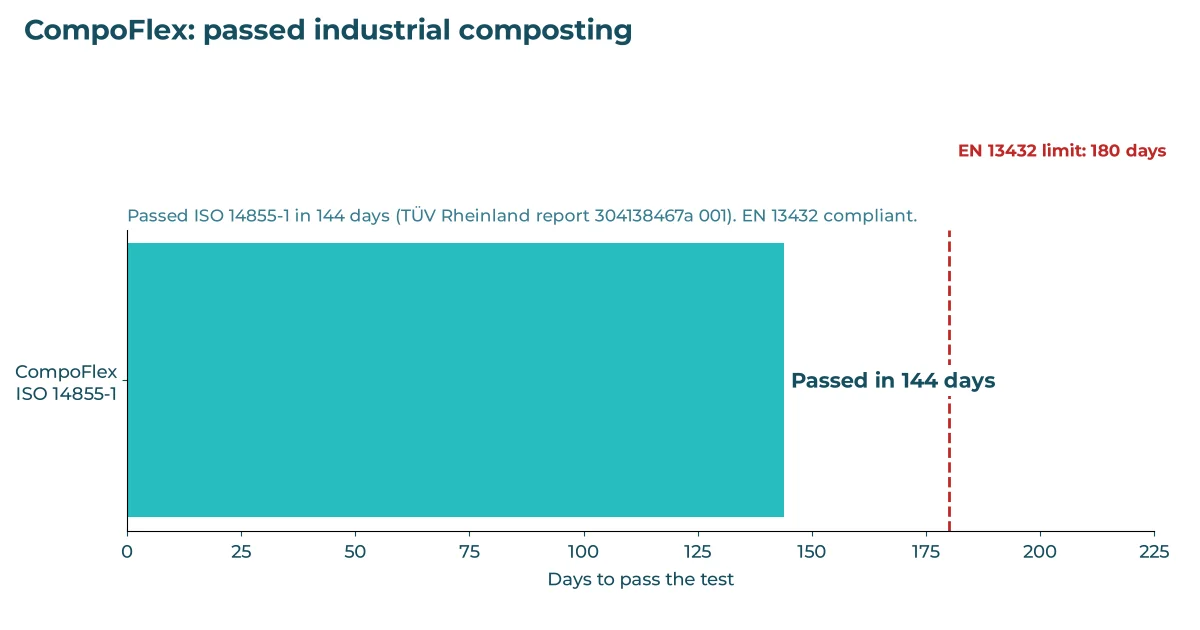
A biodegradation test is one part of four. When a supplier quotes only an ISO 14855-1 result, ask for the rest. For CompoFlex, the biodegradation result comes from the TÜV Rheinland report below, and the material is EN 13432 compliant.
CompoFlex test result
| Item | Detail |
|---|---|
| Standard | ISO 14855-1 (controlled composting, CO2 measurement) |
| Lab | TÜV Rheinland, report 304138467a 001 |
| Test period | August 2025 to January 2026 |
| Result | Passed in 144 days |
| EN 13432 status | Compliant |
That 144-day result gives a margin of more than a month against the 180-day limit. In an industrial composting facility, CompoFlex packaging returns to compost along with food waste.
The Vietnam Ecolabel decision for CompoFlex
CompoFlex bags carry the Vietnam Ecolabel ("Nhãn sinh thái Việt Nam"):
- Decision 2032/QĐ-BNNMT, May 29, 2026, issued by the Ministry of Agriculture and Environment.
- Certificate code VN-ECO-2026-004.
- Product named in the decision: "Bao bì phân hủy sinh học Compoflex".
- Assessed against criteria NSTVN-01:2023 for environmentally friendly plastic packaging (Decision 3257/QĐ-BTNMT).
- Valid for three years from signature.
For retailers this matters more than any foreign logo. Under Decree 08/2022, single-use plastic production and import must stop after 2030, except products certified with the Vietnam Ecolabel. Our guide to the Vietnam Ecolabel and supermarket rules explains the timeline.
Questions to ask any compostable bag supplier
Most claims we see in tenders fall apart on a few simple questions. Which standard was the biodegradation test run to, and how many days did it take to pass? Which lab ran it, and can you see the report number? Does the evidence cover the other parts of EN 13432, or only biodegradation? Is the product named in the Vietnam Ecolabel decision the same product you are buying, with the same formula?
A supplier with real evidence answers all of these in one email. If the answer is a logo on a brochure, ask again. We send CompoFlex report numbers and the ecolabel decision to any buyer who asks, and we would rather lose an order than overstate a result.
Using CompoFlex for retail bags and food bags
CompoFlex is used for cashier bags, bags on roll for fresh produce, and waste bags. A food contact test by Eurofins (report EFUZ26071295-CG-01, July 16, 2026) on CompoFlex biodegradable food bags passed on lead and cadmium, heavy metal migration, KMnO4 consumption and residue on evaporation.
Practical points from supplying retail customers:
- Compostable film is softer than PE, so we adjust thickness for the load a cashier bag carries.
- Store rolls cool, dry and out of sunlight, and rotate stock first in, first out.
- Print a clear disposal message. A compostable bag in a general waste bin goes to landfill like any other bag.
Since Vietnam's new plastic rules took effect in 2026, major retailers including Central Retail and MM Mega Market have chosen our CompoFlex produce roll bags for their quality.
If your packaging has to dissolve in water rather than compost, see AquaFlex PVOH film. If you need a recycled route instead, see ReFlex recycled PE.
FAQ
What is the difference between compostable and biodegradable bags? Compostable bags must biodegrade within 180 days in composting conditions, disintegrate and leave safe compost, as set by EN 13432. Biodegradable only means microorganisms break the material down, with no fixed time limit. Every compostable bag is biodegradable, but not every biodegradable bag is compostable.
Are "túi tự hủy" (oxo) bags biodegradable? No. Oxo-degradable bags are conventional plastic with an additive that makes them fragment. They break into small plastic pieces instead of biodegrading, and they would not pass EN 13432.
What does EN 13432 require? Four things: low heavy metals, a biodegradation pass within 180 days, disintegration within 12 weeks, and compost that does not harm plants. It is the European standard for compostable packaging.
How long does a CompoFlex bag take to biodegrade? CompoFlex passed ISO 14855-1 in 144 days in TÜV Rheinland testing (report 304138467a 001). That is inside the 180-day EN 13432 limit.
Does CompoFlex carry the Vietnam Ecolabel? Yes. Decision 2032/QĐ-BNNMT of May 29, 2026 granted certificate VN-ECO-2026-004 to "Bao bì phân hủy sinh học Compoflex", valid for three years.
Can compostable bags be used for food? CompoFlex food bags passed a Eurofins food contact test (report EFUZ26071295-CG-01) on heavy metal migration, KMnO4 consumption and residue on evaporation. Share your intended use with us so we confirm the right grade.
How should compostable bags be disposed of in Vietnam? Best with food and garden waste going to industrial composting or organic waste treatment. Where that is not available, they go with household waste, so retailers should explain the disposal route on the bag.
Related guides
- AquaFlex PVOH water-soluble film
- BioFlex PE-TPS biodegradable resin, and why it is not called compostable
- Recycled PE packaging, GRS and the Vietnam Ecolabel
- EPR under Decree 110/2026
- Vietnam Ecolabel rules for supermarkets
- Product page: /technology/compoflex | Certificates: /resources/certifications
Talk to us about samples: info@turngreen.world