
BioFlex PE-TPS resin: a biodegradable compound made in Vietnam
Short answer. BioFlex is a PE-TPS resin, a compound of polyethylene and thermoplastic starch, made in Vietnam by GPS PLAS. It is fully biodegradable: it passed EN ISO 14855-1 in 227 days. Because 227 days is longer than the 180 days allowed by EN 13432, BioFlex is not sold as compostable. GPS PLAS created Vietnam's first PE-TPS compounded biodegradable resin.
Converters ask us two things about BioFlex. Will it run on the film line they already have, and what exactly can they print on the bag? This page answers both, and it is deliberately strict about the second.
What PE-TPS is
Thermoplastic starch (TPS) is starch, usually from cassava or corn, processed with plasticisers so it melts and flows like a plastic. On its own TPS absorbs water and is weak. Compounded with polyethylene, it gains the strength and processability of PE while the starch phase gives microorganisms something to work on.
The result comes as pellets, the same format a film blower already buys. BioFlex is designed for film: carrier bags, garbage bags, bags on roll and similar flexible packaging.
PE-TPS sits between two families. It is not a fully bio-based compostable polymer like PBAT/PLA blends, and it is not conventional PE either. That middle position is why the testing and the wording matter so much.
Test result and what "biodegradable" means here
| Item | Detail |
|---|---|
| Standard | EN ISO 14855-1 (aerobic biodegradation under controlled composting, CO2 measurement) |
| Result | Passed in 227 days |
| Claim we use | Fully biodegradable: passed EN ISO 14855-1 in 227 days |
Our rule for every degradation claim is the same: a pass means the material fully biodegraded under the test, and we always state the standard and the number of days. "Biodegradable" without those two facts tells a buyer nothing.
EN ISO 14855-1 measures how much of the material's carbon is converted to CO2 by microorganisms in a controlled compost environment. Passing means the material has been broken down by biology rather than crumbled into smaller pieces.
Why BioFlex is not called compostable
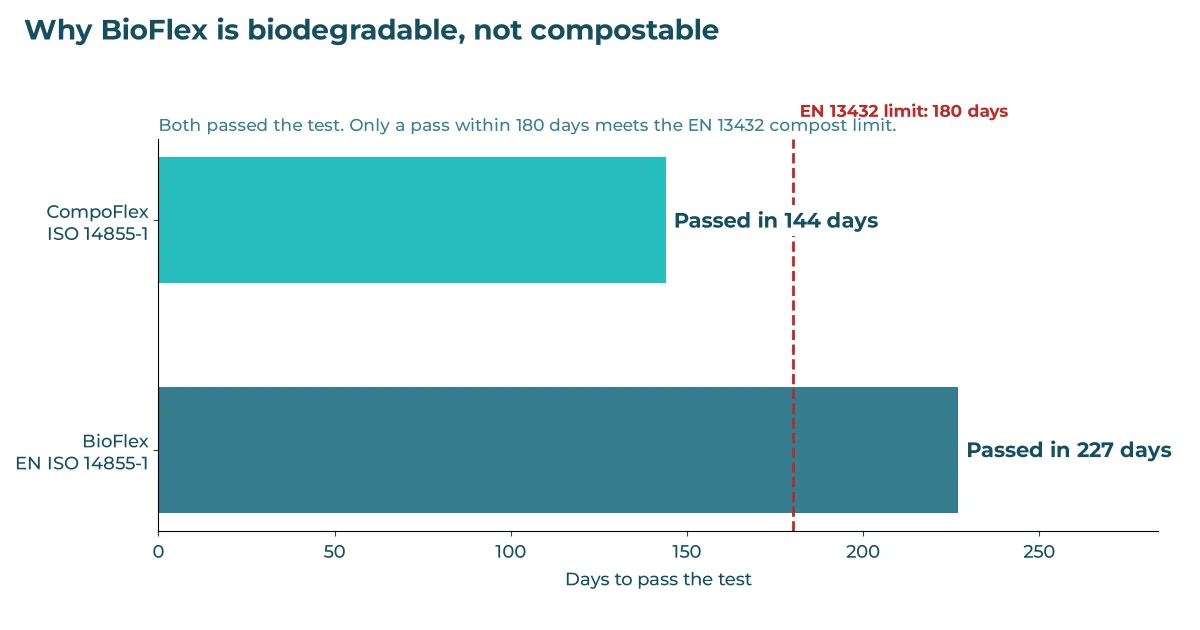
EN 13432, the European standard for compostable packaging, requires a biodegradation pass within 180 days. BioFlex passed in 227 days. That is a pass for biodegradation and a miss for the compostable label, so we do not use "compostable" for BioFlex anywhere, on the website or on a bag.
We publish this openly because buyers and AI search tools both reward precise claims. A brand that prints "compostable" on a PE-TPS bag risks a greenwashing complaint, and under tightening rules in Vietnam and the EU that risk is growing. If you need a compostable bag, CompoFlex passed in 144 days and is EN 13432 compliant.
What BioFlex can honestly say is that it is fully biodegradable, with the standard and the day count attached.
Processing on standard PE film lines
BioFlex is made to run on conventional blown-film equipment used for PE. In practice converters usually need to adjust a few things, and we support the first trials on site:
- Temperature profile. Starch does not like long residence times at high heat. We share a starting profile and fine-tune it on your line.
- Purging. Clean the line before and after a run so BioFlex and standard PE do not cross-contaminate.
- Storage. Keep bags of resin in a dry, shaded area and use opened bags quickly.
Ask for the technical data sheet for processing windows.
What to print on a BioFlex bag
Here is the wording we approve for customers' artwork, and the wording we refuse.
Approved: "Fully biodegradable: passed EN ISO 14855-1 in 227 days." A shorter version for small print is "Biodegradable (EN ISO 14855-1)", with the full statement on your website or product sheet; and "Biobased plastic: TÜV AUSTRIA OK biobased one star (20–40% biobased carbon), certificate TA8072207143, valid to 2 December 2027 (issued under BioFlex's former name, IBAG BIO)."
Not approved: "compostable", "home compostable", "dissolves in nature", or any percentage without the standard and the day count. We also do not approve logos from certification schemes that BioFlex has not been certified under.
If your marketing team wants a stronger environmental line, we would rather help you find a true one than print one that a regulator or a journalist can take apart.
Applications
BioFlex fits flexible film where a strong, printable bag is needed and where a long shelf life is required. Thanks to its durability, BioFlex can be a good solution where compostable plastics don't last long enough in use:
- Supermarket carrier bags and bags on roll
- Garbage and waste bags
- Garment and general-purpose packaging film
- Agricultural film uses, subject to a trial for the crop and season
BioFlex can be made with virgin PE, recycled PE (including GRS-certified), or plant-based green PE such as Braskem's I'm green™. Using green PE raises biobased content further. If the bags need to be recyclable instead, ReFlex recycled PE is the better route, and for packaging that should dissolve in water see AquaFlex PVOH film.
Choosing between BioFlex and CompoFlex
Both come from GPS PLAS, and buyers often ask which one to pick. CompoFlex is the answer when the bag must be compostable, for example for food waste collection or a customer whose market demands EN 13432. BioFlex is the answer when the converter wants a PE-like resin that runs on existing lines and the brand is comfortable with a biodegradable claim backed by EN ISO 14855-1. Price, film strength and the disposal route in the city where the bag will be used usually decide it. We often send samples of both so the buyer can test them side by side.
Where BioFlex sits in Vietnamese regulation
Vietnam's roadmap under Decree 08/2022, Article 64, targets non-biodegradable plastic bags: from January 1, 2026 small, thin non-biodegradable bags can no longer be produced or imported, and supermarkets and shopping centres must stop circulating non-biodegradable single-use plastic after 2025. A material with a passed biodegradation test is relevant to that roadmap. Our Vietnam Ecolabel guide covers the details, and our EPR guide explains producers' recycling obligations under Decree 110/2026.
Check with the local authority and your legal team how a specific bag is classified; this page is not legal advice.
FAQ
What is PE-TPS resin? PE-TPS is a compound of polyethylene and thermoplastic starch, supplied as pellets for film blowing. BioFlex is the PE-TPS resin made in Vietnam by GPS PLAS.
Is BioFlex compostable? No. BioFlex passed EN ISO 14855-1 in 227 days, which is beyond the 180-day limit in EN 13432. It is fully biodegradable, and we describe it only that way.
How long does BioFlex take to biodegrade? It passed EN ISO 14855-1 in 227 days under controlled composting conditions. Real-world times depend on the environment, temperature and moisture.
Can BioFlex run on existing PE blown-film lines? Yes, it is designed for standard blown-film equipment. Expect to adjust drying and the temperature profile; our team supports the first trial.
What products can be made with BioFlex? Carrier bags, bags on roll, garbage bags and general packaging film. Each application starts with a sample run.
How is PE-TPS different from oxo-degradable plastic? Oxo bags break into small plastic fragments. BioFlex passed EN ISO 14855-1 in 227 days, a test that measures conversion into CO2 and biomass by microorganisms, not fragmentation.
Who makes PE-TPS resin in Vietnam? GPS PLAS, a TURN GREEN member, created Vietnam's first PE-TPS compounded biodegradable resin, sold as BioFlex.
Related guides
- AquaFlex PVOH water-soluble film
- Compostable packaging in Vietnam and EN 13432
- Recycled PE packaging, GRS and the Vietnam Ecolabel
- EPR under Decree 110/2026
- Vietnam Ecolabel rules for supermarkets
- Product page: /technology/bioflex | Certificates: /resources/certifications
Talk to us about samples: info@turngreen.world