
Vietnam Ecolabel for plastic packaging: what manufacturers must meet and why supermarkets are affected
Short answer. The Vietnam Ecolabel for plastic packaging is a voluntary certification issued under criteria NSTVN-01:2023 (Decision 3257/QĐ-BTNMT). What applies to every manufacturer and retailer is Decree 08/2022, Article 64: from January 1, 2026, non-biodegradable plastic bags under 50 x 50 cm and thinner than 50 µm may not be produced or imported; after 2025, non-biodegradable single-use plastic and bags should not be circulated in supermarkets and shopping centres. Vietnam Ecolabel certification is independent proof that a bag meets the national criteria for environmentally friendly plastic packaging. It is not a legal exemption from the plastic bag phase-out rules in Decree 08/2022.
Purchasing teams at supermarkets keep asking us the same thing: "Is the ecolabel mandatory now?" Not exactly, but the rules around it make it hard to ignore. This guide explains both layers and how to check a supplier.
What the Vietnam Ecolabel for plastic packaging is
The Vietnam Ecolabel ("Nhãn sinh thái Việt Nam") is the national environmental label. For plastic packaging, the criteria were set by Decision 3257/QĐ-BTNMT of November 7, 2023, under the code NSTVN-01:2023, "environmentally friendly plastic packaging". Certification is now handled by the Ministry of Agriculture and Environment, which took over the environment portfolio, so recent decisions carry the code QĐ-BNNMT.
A manufacturer applies for a specific product, the ministry assesses it against the criteria, and a decision is issued with a certificate code in the form VN-ECO-year-number. The certificate is valid for three years.
The criteria: biodegradable bags and recycled PE/PP bags
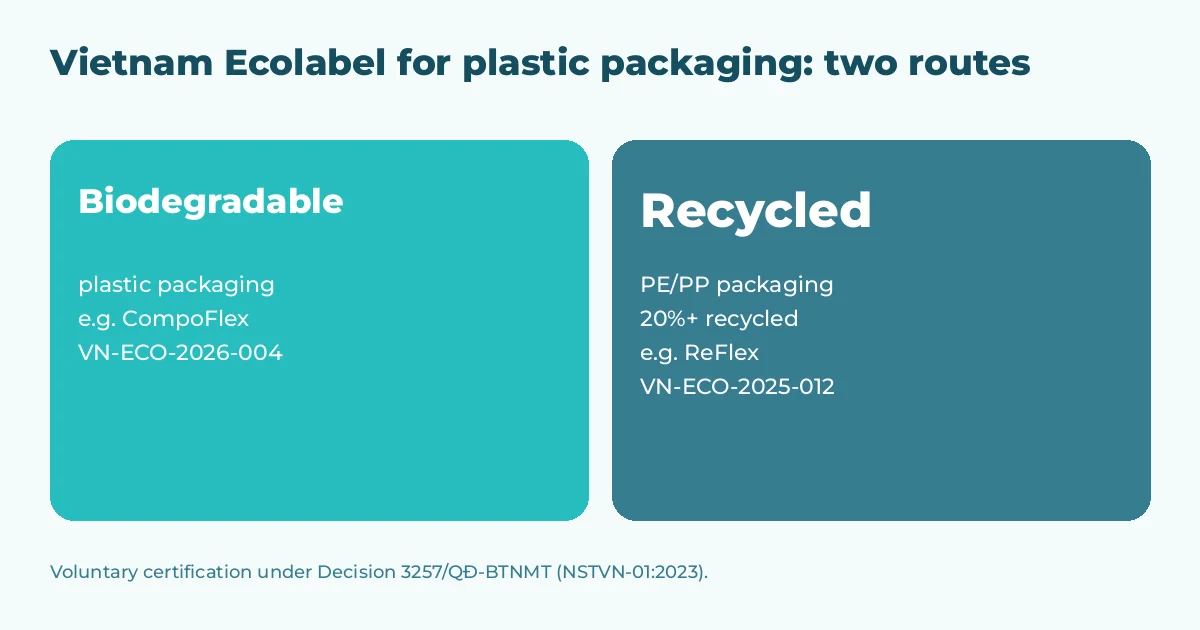
NSTVN-01:2023 has two routes:
Biodegradable plastic packaging. The bag must meet biodegradation requirements set in the criteria, backed by test reports. Our CompoFlex bags were certified on this route: Decision 2032/QĐ-BNNMT of May 29, 2026, certificate VN-ECO-2026-004, and CompoFlex passed ISO 14855-1 in 144 days.
Recycled PE and PP packaging. The bag must contain at least 20% recycled resin, be 50 µm thick or more, and measure at least 50 cm on each side. Our ReFlex bags were certified on this route: Decision 4054/QĐ-BNNMT of September 30, 2025, certificate VN-ECO-2025-012.
The 50 µm and 50 cm figures in the recycled route line up with the Decree 08/2022 cut-off for banned bags. Bags above that size and thickness are meant to be reused, not thrown away after one shop.
The legal timeline behind it (Decree 08/2022, Article 64)
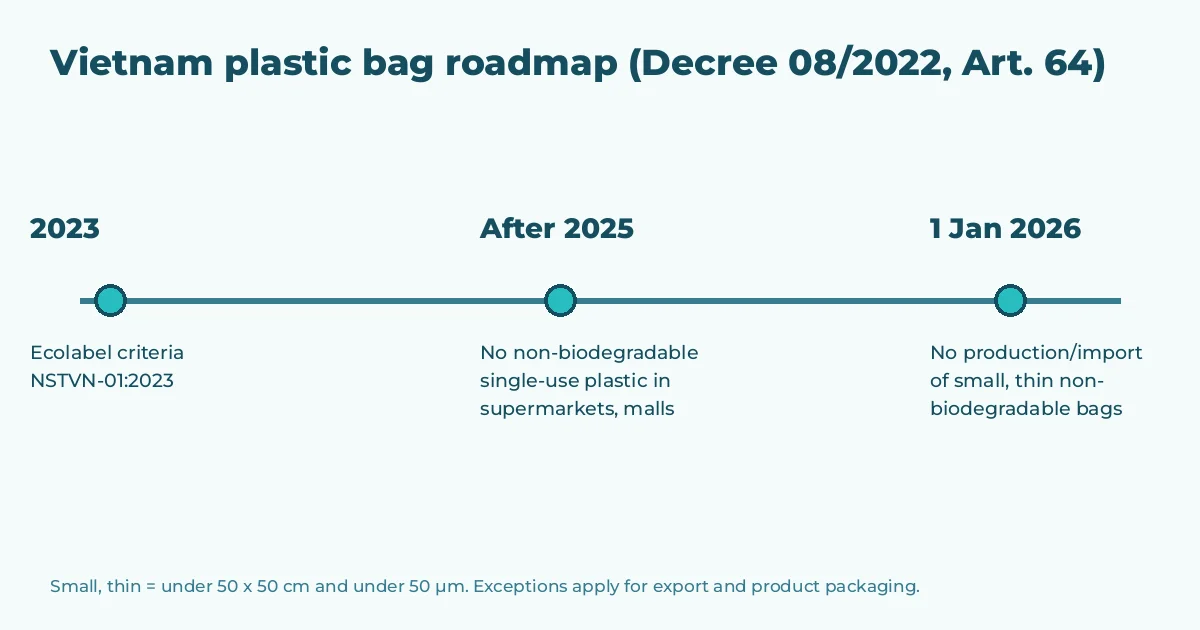
Article 64 of Decree 08/2022/NĐ-CP sets the roadmap for restricting single-use plastic and non-biodegradable plastic packaging:
- After 2025: provinces must ensure that non-biodegradable single-use plastic products and plastic bags are not circulated or used in shopping centres, supermarkets, hotels and tourist sites.
- From January 1, 2026: no production or import of non-biodegradable plastic bags smaller than 50 x 50 cm and thinner than 50 µm, except for export or for packaging products.
Vietnam Ecolabel certification is independent proof that a bag meets the national criteria for environmentally friendly plastic packaging. It is not a legal exemption from the plastic bag phase-out rules in Decree 08/2022.
Supermarkets do not need to be ecolabel-certified themselves. They are affected because they are the places the 2025 rule names, and because the bags they give out are made by manufacturers who must follow the Decree 08/2022 phase-out rules.
What this means for supermarkets and shopping malls
For a retail chain, the safe position from 2026 is simple to state: any single-use bag at the till, in the fresh section or in the bin liner aisle should be either biodegradable with test evidence, or a thicker reusable bag of 50 x 50 cm and 50 µm or more. Asking for ecolabel-certified bags is the most direct way to show compliance, because the certificate is issued by the ministry against published criteria.
Decree 110/2026 adds two separate duties: recycling for private-label packaging, and a waste-treatment contribution paid by producers and importers of small non-biodegradable carrier bags.
How to check a supplier's certificate
- Ask for the decision number and the certificate code (VN-ECO-...).
- Check that the product named in the decision matches the product you are buying, including material and size.
- Check the date: the certificate is valid for three years from signature.
- Ask for the test reports behind the certificate, especially the biodegradation result with the standard and the number of days.
- Treat "tự hủy" or oxo-degradable bags with caution. They fragment rather than biodegrade, and they do not meet the biodegradable route.
If a supplier cannot produce a decision number, the bag is not ecolabel-certified, whatever is printed on it.
A note on wording at the till
Shoppers read what is printed on a bag, so the wording matters as much as the certificate. A bag with the Vietnam Ecolabel can carry the certificate code. A biodegradable bag should state the standard and the days, for example "passed ISO 14855-1 in 144 days". Avoid "tự hủy", which consumers now link with oxo bags.
TURN GREEN's two certified product lines
| Product | Route | Decision | Certificate |
|---|---|---|---|
| CompoFlex biodegradable packaging | Biodegradable | 2032/QĐ-BNNMT, May 29, 2026 | VN-ECO-2026-004 |
| ReFlex recycled PE packaging | Recycled PE | 4054/QĐ-BNNMT, Sept 30, 2025 | VN-ECO-2025-012 |
Read more on CompoFlex and EN 13432 and on ReFlex and GRS.
FAQ
What is the Vietnam Ecolabel for plastic packaging? It is the national environmental label for plastic packaging, issued under criteria NSTVN-01:2023 (Decision 3257/QĐ-BTNMT, 2023). It covers biodegradable plastic packaging and recycled PE/PP packaging.
Is the Vietnam Ecolabel mandatory? Vietnam Ecolabel certification is independent proof that a bag meets the national criteria for environmentally friendly plastic packaging. It is not a legal exemption from the plastic bag phase-out rules in Decree 08/2022.
Can supermarkets in Vietnam still give out plastic bags in 2026? Yes, but not non-biodegradable single-use bags. After 2025, these should not be circulated in supermarkets and shopping centres; biodegradable bags with evidence, or reusable bags of at least 50 x 50 cm and 50 µm, remain possible.
What bag sizes and thicknesses are banned from January 1, 2026? Non-biodegradable plastic bags smaller than 50 x 50 cm and thinner than 50 µm may not be produced or imported, except for export and for product packaging.
How can a retailer verify a supplier's eco-label certificate? Ask for the decision number and VN-ECO certificate code, check that the named product matches what you buy, and check the three-year validity date.
Which ministry issues the Vietnam Ecolabel now? The Ministry of Agriculture and Environment, which is why recent decisions carry the code QĐ-BNNMT. The 2023 criteria were issued by the former Ministry of Natural Resources and Environment (QĐ-BTNMT).
Related guides
- AquaFlex PVOH water-soluble film
- Compostable packaging in Vietnam and EN 13432
- BioFlex PE-TPS biodegradable resin
- Recycled PE packaging, GRS and the Vietnam Ecolabel
- EPR under Decree 110/2026
- Certificates: /resources/certifications
Sources: Decree 08/2022/NĐ-CP | Decree 05/2025/NĐ-CP amending Decree 08/2022 | Ministry of Industry and Trade on the post-2025 supermarket plastic roadmap (Art. 64) | Ministry of Industry and Trade on Decision 3257/QĐ-BTNMT (NSTVN-01:2023)
Talk to us about certified bags: info@turngreen.world