
EPR in Vietnam under Decree 110/2026: what packaging producers and importers must do
Short answer. Decree 110/2026/NĐ-CP sets out extended producer responsibility (EPR) in Vietnam. It was issued on April 1, 2026 and took effect on May 25, 2026. Producers and importers of covered goods must either recycle a fixed share of the packaging they place on the market, at rates from 10% to 22% depending on the material, or pay a financial contribution to the Vietnam Environmental Protection Fund. Plans and reports are due before April 1 each year, and contributions must be paid before April 20.
Decree 110 details Articles 54 and 55 of the Law on Environmental Protection. For packaging teams the practical questions are always the same: are we covered, how much, by when, and does our choice of material change anything. This guide answers them from the decree text published in the Official Gazette (Công báo No. 229, April 19, 2026). It is a summary, not legal advice.
Who is covered
The recycling obligation applies to producers and importers that place on the Vietnamese market the products and packaging listed in Appendix I of the decree. For packaging, it covers the commercial packaging, both direct and outer, of:
- food (except chewing gum)
- cosmetics
- medicines
- fertilisers, animal feed and veterinary drugs
- soaps, detergents and cleaning preparations for household, agricultural and medical use
- cement
Several situations are spelled out. When the same brand is made by several manufacturers, the party responsible for the product label carries the obligation. When production is outsourced, the company that places the order is responsible, not the contract manufacturer. For entrusted imports, the party responsible for labelling is responsible.
Three groups are exempt: goods made or imported for export, temporary import and re-export, or research and testing; producers and importers whose revenue from the covered goods is under VND 30 billion a year; and producers that take back and reuse their own packaging at a rate equal to or above the mandatory recycling rate.
Mandatory recycling rates for packaging
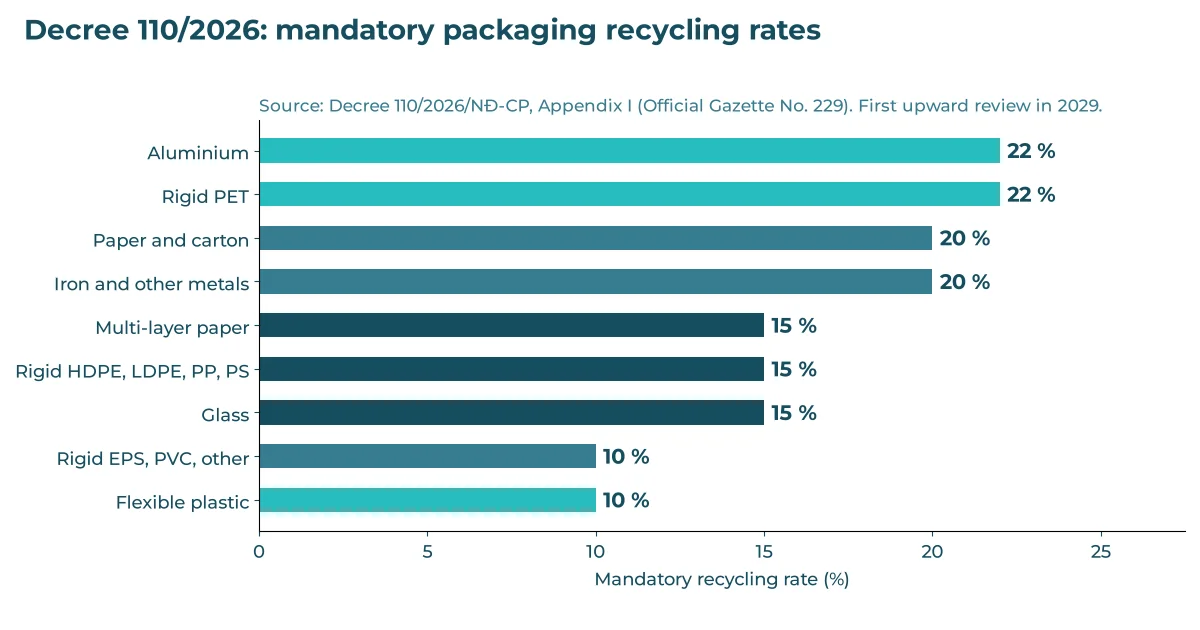
The rates in Appendix I are the minimum share, by weight, of the packaging placed on the market in a year that must be recycled to the required specification.
| Packaging | Mandatory rate |
|---|---|
| Paper and carton | 20% |
| Multi-layer mixed paper packaging | 15% |
| Aluminium | 22% |
| Iron and other metals | 20% |
| Rigid PET | 22% |
| Rigid HDPE, LDPE, PP, PS | 15% |
| Rigid EPS, PVC and other rigid plastic (except biodegradable plastic) | 10% |
| Flexible plastic packaging, mono and multi-material | 10% |
| Glass | 15% |
For plastics, the recycling must produce commercial resin pellets or specific packaging or products. Plastic flakes do not count, and for rigid plastics neither does fuel. The rates will be raised every three years by the Minister of Agriculture and Environment, by no more than 10% each time, starting in 2029. If a producer recycles more than required, the surplus can be carried forward to later years.
Source: Decree 110/2026/NĐ-CP, Official Gazette.
Ways to comply
The Law on Environmental Protection gives producers and importers a choice:
- Recycle in house, by setting up collection points with distributors or other take-back channels and recycling through a facility they own.
- Hire a recycler to do the recycling on their behalf.
- Authorise a producer responsibility organisation to organise collection and recycling.
- Pay a financial contribution into the Vietnam Environmental Protection Fund.
The contribution is calculated as F = R × V × Fs: the mandatory rate, times the weight placed on the market, times a rate per kilogram (Fs) set by the Minister for each packaging type. Fs is also reviewed every three years from 2029. Companies that choose to pay do not have to register a recycling plan or report recycling results.
Deadlines and reporting
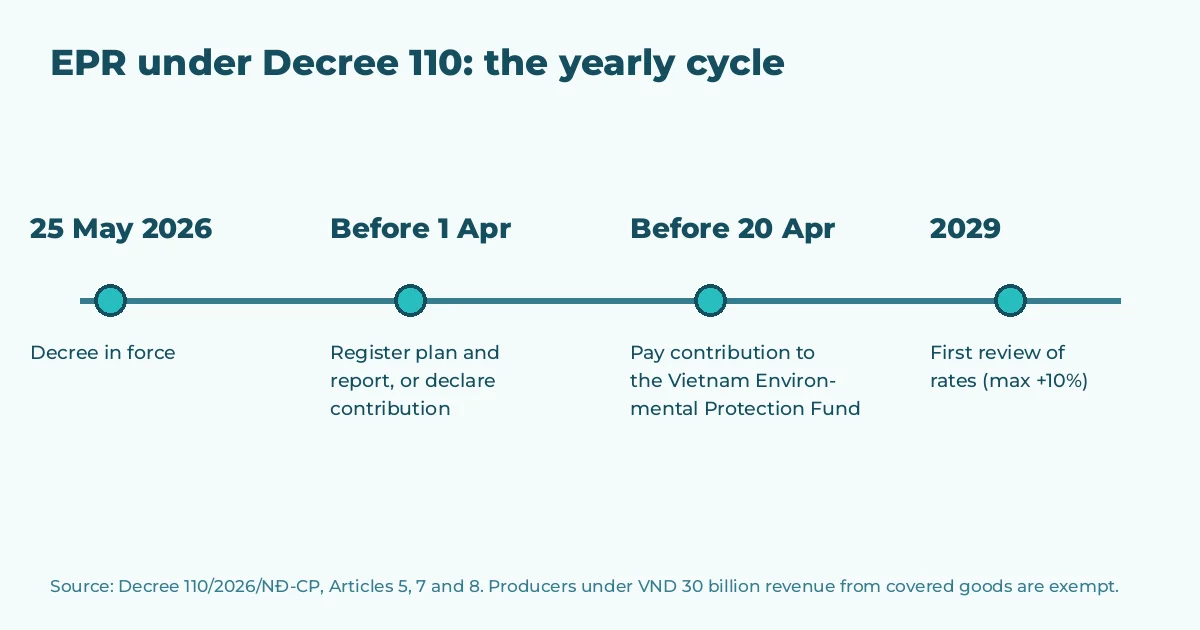
- Before April 1 each year: register the recycling plan for the packaging placed on the market in the previous year and report the previous year's recycling results, through the national EPR information system. Companies that choose to pay declare their contribution by the same date.
- Before April 20 each year: pay the declared contribution to the Vietnam Environmental Protection Fund.
- 2029: first review of recycling rates and of Fs.
The forms come from the Ministry of Agriculture and Environment, with guidance in Circular 24/2026/TT-BNNMT. Producers carry full legal responsibility for the accuracy of what they declare.
How material choice changes the obligation
Here we stay close to the text. The decree sets rates by packaging material and format, so switching materials can move packaging into a different row of Appendix I. One row, rigid EPS, PVC and other rigid plastic, expressly excludes biodegradable plastic. Beyond that, the decree does not grant a general reduction for biodegradable or recycled-content packaging. Separately, the waste-treatment contribution for carrier bags (Appendix II, item 6.8) covers non-biodegradable bags only.
What material choice does change is practical. Packaging that is easy to recycle, such as mono-material PE, gives recyclers material they can turn into pellets, which is the specification the decree requires. Lighter packaging lowers V, the weight in the formula. Our ReFlex recycled PE is a mono-material recyclable option, and our CompoFlex and BioFlex materials answer a separate set of rules: the plastic bag roadmap in Decree 08/2022 and, for small non-biodegradable carrier bags, the Decree 110 waste-treatment contribution, explained in our Vietnam Ecolabel guide.
What to do before the next April deadline
For a company placing covered packaging on the market, a short plan covers most of the work. Start by listing every packaging item by material and format, using the rows in Appendix I, and weigh what was placed on the market last year. Check whether the VND 30 billion revenue threshold applies. Then decide between recycling, alone or through a recycler or producer responsibility organisation, and paying the contribution. Many companies run the numbers both ways before choosing. Finally, look at the packaging itself: switching to mono-material formats and lighter specifications reduces cost under either route.
FAQ
What is Decree 110/2026/NĐ-CP? It is the Vietnamese government decree on producers' and importers' responsibility to recycle products and packaging and to contribute to waste treatment. It details Articles 54 and 55 of the Law on Environmental Protection.
When did EPR under Decree 110 take effect? On May 25, 2026. The decree was issued on April 1, 2026 and signed by Deputy Prime Minister Trần Hồng Hà.
What are the recycling rates for plastic packaging? Rigid PET 22%, rigid HDPE, LDPE, PP and PS 15%, rigid EPS, PVC and other rigid plastic 10%, and flexible plastic packaging 10%, according to Appendix I.
Can a company pay instead of recycling? Yes. It can pay a financial contribution to the Vietnam Environmental Protection Fund, calculated as rate × weight × Fs. It must declare before April 1 and pay before April 20 each year.
Does EPR apply to importers? Yes. Importers of covered products and packaging carry the same recycling obligation as domestic producers, unless an exemption such as the VND 30 billion revenue threshold applies.
Are retailers covered by EPR? A retailer is covered when it is the producer or importer, or when it is the party responsible for the label, for example on own-brand products. Selling other brands' goods does not on its own create the obligation. Retailers that import small non-biodegradable carrier bags, or have them made under their own label, also pay the waste-treatment contribution (Art. 9, Appendix II item 6.8).
Does biodegradable or recycled packaging reduce EPR obligations? The decree gives no general reduction for either. Biodegradable plastic is excluded from one rigid plastic category in Appendix I; otherwise obligations depend on the packaging type and weight. Check your case with an EPR adviser. Separately, the waste-treatment contribution for carrier bags (Appendix II, item 6.8) covers non-biodegradable bags only.
Related guides
- AquaFlex PVOH water-soluble film
- Compostable packaging in Vietnam and EN 13432
- BioFlex PE-TPS biodegradable resin
- Recycled PE packaging, GRS and the Vietnam Ecolabel
- Vietnam Ecolabel rules for supermarkets
- Certificates: /resources/certifications
Sources: Decree 110/2026/NĐ-CP, Official Gazette | Government legal documents portal | Circular 24/2026/TT-BNNMT
Talk to us about packaging and EPR: info@turngreen.world