
Supermarket and retail plastic bag rules in Vietnam for 2026: what a cashier bag must meet
The checkout counter is where Vietnam's plastic bag rules become visible to shoppers. A purchasing team choosing next year's cashier bag needs two answers: what the law now says, and which bag meets it with evidence a buyer can check.
A question we hear from purchasing teams is whether the Vietnam Ecolabel is now mandatory. The short answer is yes, plastic bags must be made under one of the two Ecolabel certificates. This guide covers the rules first, then the bag.
What changed in 2026 at the supermarket checkout counter
Both dates below come from Article 64 of Decree 08/2022/NĐ-CP.
After 2025: no non-biodegradable single-use plastic in supermarkets
Provincial People's Committees must ensure that, after 2025, single-use plastic products and non-biodegradable plastic packaging, including non-biodegradable plastic bags, are not circulated or used in shopping centres, supermarkets, hotels and tourist sites. Goods that already come in non-biodegradable packaging are exempted.
From 1 January 2026: small, thin non-biodegradable bags stop
Non-biodegradable plastic bags smaller than 50 cm x 50 cm, with a single-layer film thinner than 50 µm, may no longer be produced or imported. The exceptions are production for export, and production or import for packaging goods sold on the market.
What the Vietnam Ecolabel proves
Vietnam Ecolabel certification is independent proof that a bag meets the national criteria for environmentally friendly plastic packaging.
Two compliant routes for a cashier bag
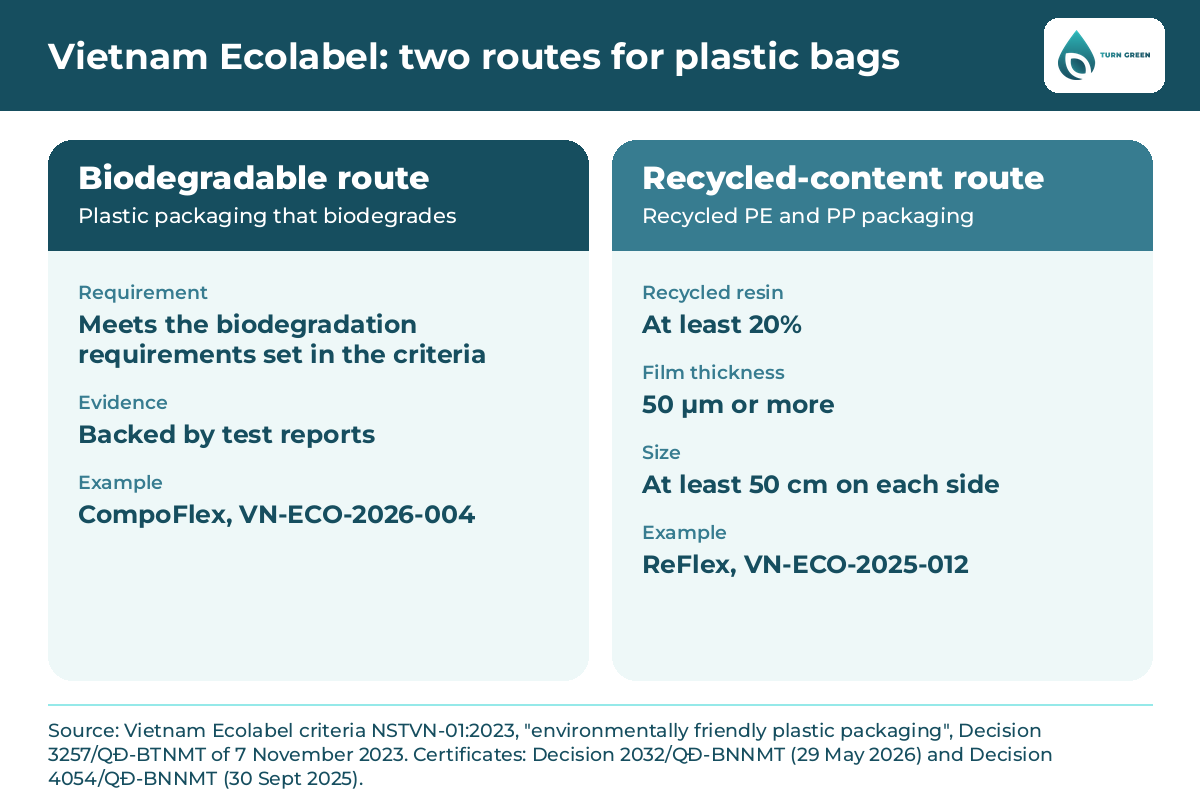
Biodegradable, with test evidence: CompoFlex
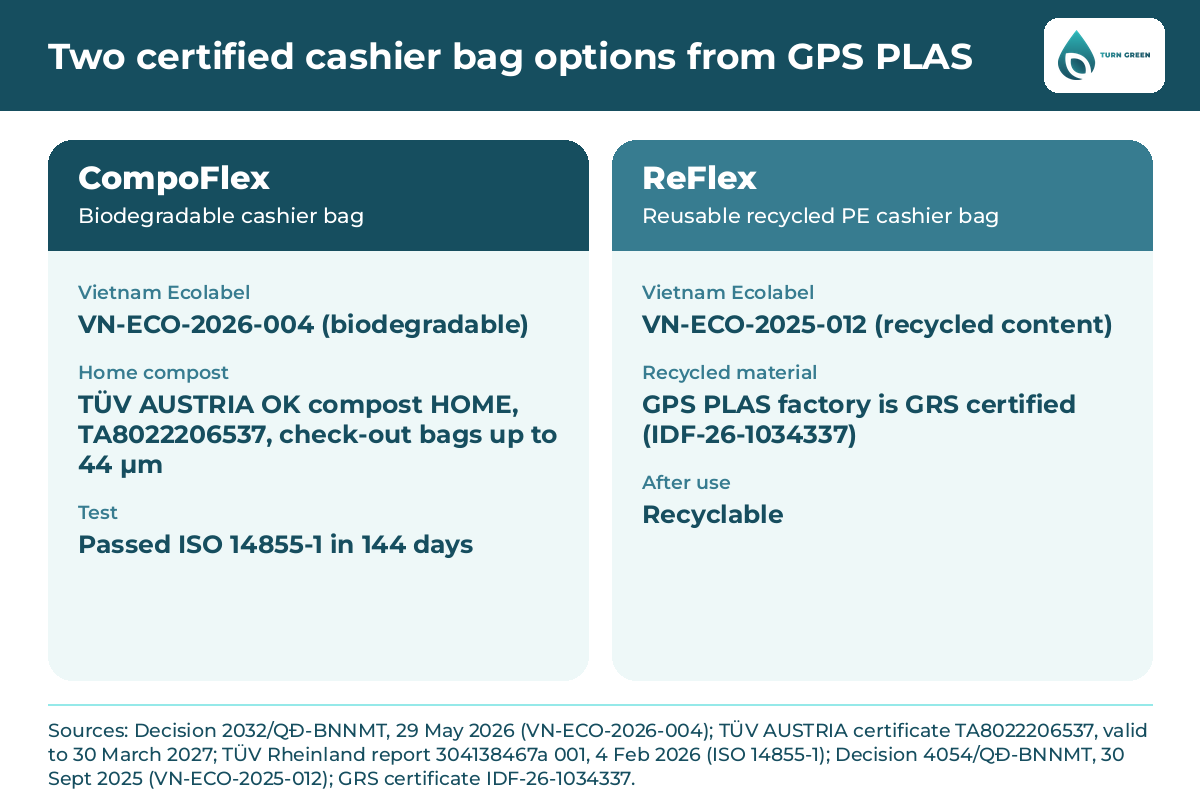
CompoFlex, made by GPS PLAS, holds the Vietnam Ecolabel for biodegradable under Decision 2032/QĐ-BNNMT of 29 May 2026, certificate VN-ECO-2026-004. It is also compliant with export standards such as ISO 14855-1 and EN13432.
Reusable, recycled and above the size line: ReFlex
ReFlex, made by GPS PLAS, holds the Vietnam Ecolabel for recycled content under Decision 4054/QĐ-BNNMT of 30 September 2025, certificate VN-ECO-2025-012. It is also compliant to international standard with its GRS certification for post consumer waste recycled plastic.
The ecolabel criteria for recycled bags ask for at least 20% recycled resin, a film of 50 µm or more, and each side of at least 50 cm. Those size and thickness figures sit on the same line as the 2026 rule, so a ReFlex bag is built to be reused. ReFlex is recyclable after use.
Practical points for a chain switching cashier bags
Thickness and load
Compostable film is softer than PE, so we adjust the thickness of a CompoFlex cashier bag to the load it has to carry.
Storage
Compostable bags need to be managed properly applying a good stock rotation on a first in first out basis due to their limited shelf-life making them best for use within 9 months.
What to print on the bag
Print the standard and the days, for example "passed ISO 14855-1 in 144 days", or the VN-ECO certificate code. Avoid "tự hủy", which shoppers now link with oxo bags that fragment into micro plastics.
Talk to us
Request CompoFlex or ReFlex cashier bag samples: info@turngreen.world
FAQ
Can supermarkets in Vietnam still give out plastic bags in 2026?
Yes, Biodegradable bags with test evidence, or reusable bags of at least 50 x 50 cm and 50 µm, remain options. Under Decree 08/2022, Article 64, bags out of the Ecolabel ruling should not be circulated or used in supermarkets and shopping centres after 2025.
Is the Vietnam Ecolabel mandatory for cashier bags?
Yes, cashier bags must be manufactured under one of the two certified VN Ecolabels. Failing to do so comes with a ~2$ tax per kg produced making it uncompetitive.
Which bags are banned from 1 January 2026?
Non-biodegradable plastic bags smaller than 50 cm x 50 cm with a single-layer film thinner than 50 µm may not be produced or imported, except for export or for packaging goods sold on the market.
Are "túi tự hủy" bags compliant?
Oxo "tự hủy" bags fragment rather than biodegrade, and they do not meet the biodegradable route of the Vietnam Ecolabel.
Is a CompoFlex cashier bag home compostable?
CompoFlex passed ISO 14855-1 in 144 days and holds Vietnam Ecolabel VN-ECO-2026-004.