
Decree 110 FAQ for retailers and FMCG brands: who pays for packaging recycling in Vietnam
Decree 110/2026/NĐ-CP was issued on 1 April 2026 and has been in force since 25 May 2026. It details Articles 54 and 55 of the Law on Environmental Protection, on producers' and importers' responsibility to recycle products and packaging and to contribute to waste treatment.
This FAQ is written for FMCG brand owners and private-label teams at retailers. It is a summary of the decree text, not legal advice. For a longer walkthrough, see our full Decree 110 guide.
Carrier bags and product packaging: what applies
Carrier bags at the checkout counter
The phase-out dates for cashier bags, produce roll bags and other carrier bags are in Decree 08/2022, Article 64. Decree 110 adds a waste-treatment payment: producers and importers of non-biodegradable carrier bags smaller than 50 x 50 cm with a single-layer film thinner than 50 µm pay into the Vietnam Environmental Protection Fund (Article 9, Appendix II item 6.8). Biodegradable bags and household waste bags specified by local authorities are outside that item.
Our guide to the supermarket bag rules for 2026 covers the phase-out dates.
Packaging of listed goods and own-brand products
The Decree 110 recycling duty concerns the commercial packaging of listed goods, including own-brand products. That is the main subject of this FAQ.
Is my company covered?
Covered: producers and importers of listed goods
The recycling obligation applies to producers and importers that place the products and packaging in Appendix I on the Vietnamese market. For packaging, it covers the commercial packaging, direct and outer, of food (except chewing gum), cosmetics, medicines, fertilisers, animal feed and veterinary drugs, soaps, detergents and cleaning preparations, and cement.
Own brand and outsourced production
When the same brand is made by several manufacturers, the party responsible for the product label carries the obligation. When production is outsourced, the company that places the order is responsible, not the contract manufacturer. For entrusted imports, the party responsible for the label is responsible.
Exempt
Goods made or imported for export, temporary import and re-export, or research and testing. Producers and importers whose revenue from the covered goods is under VND 30 billion a year. Producers that take back and repackage their own packaging at a rate equal to or above the mandatory recycling rate.
The rates for FMCG packaging (Appendix I)
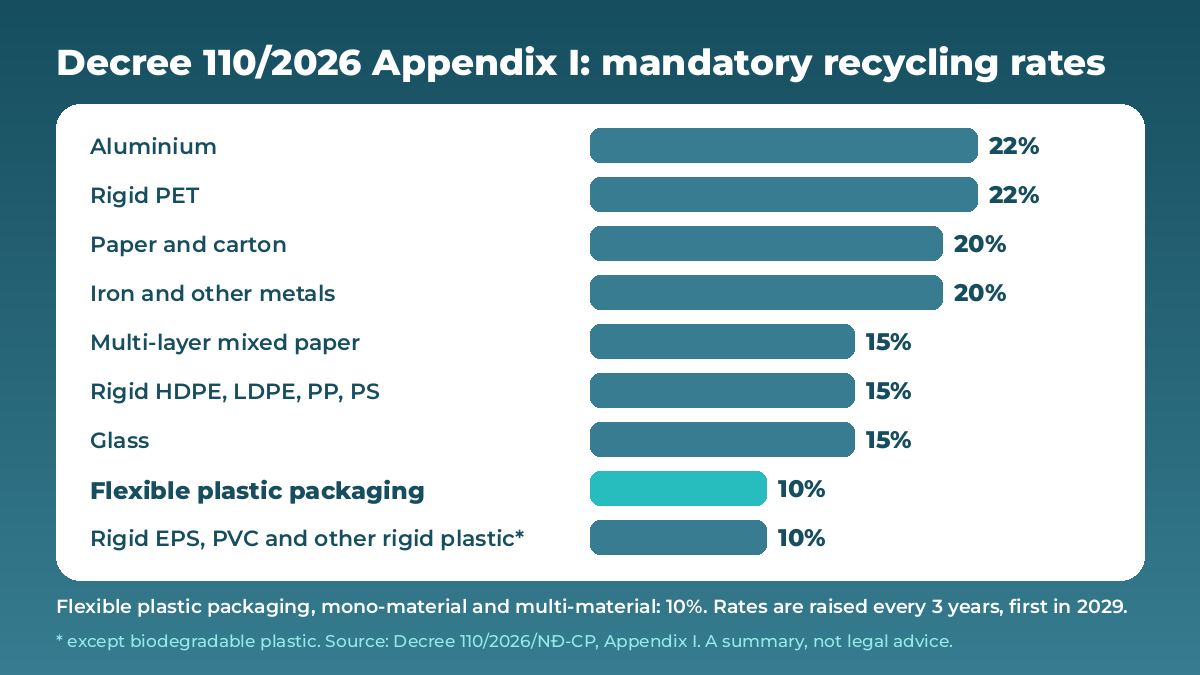
Flexible plastic packaging: 10%
Flexible plastic packaging, mono-material and multi-material, has a mandatory recycling rate of 10%.
The other packaging rows
| Packaging | Mandatory rate |
|---|---|
| Paper and carton | 20% |
| Multi-layer mixed paper | 15% |
| Aluminium | 22% |
| Iron and other metals | 20% |
| Rigid PET | 22% |
| Rigid HDPE, LDPE, PP, PS | 15% |
| Rigid EPS, PVC and other rigid plastic (except biodegradable plastic) | 10% |
| Glass | 15% |
What counts as recycling
For plastics, recycling must produce commercial resin pellets or specific packaging or products; plastic flakes do not count. The rates are raised every 3 years, by no more than 10% each time, with the first change in 2029.
Recycle or pay
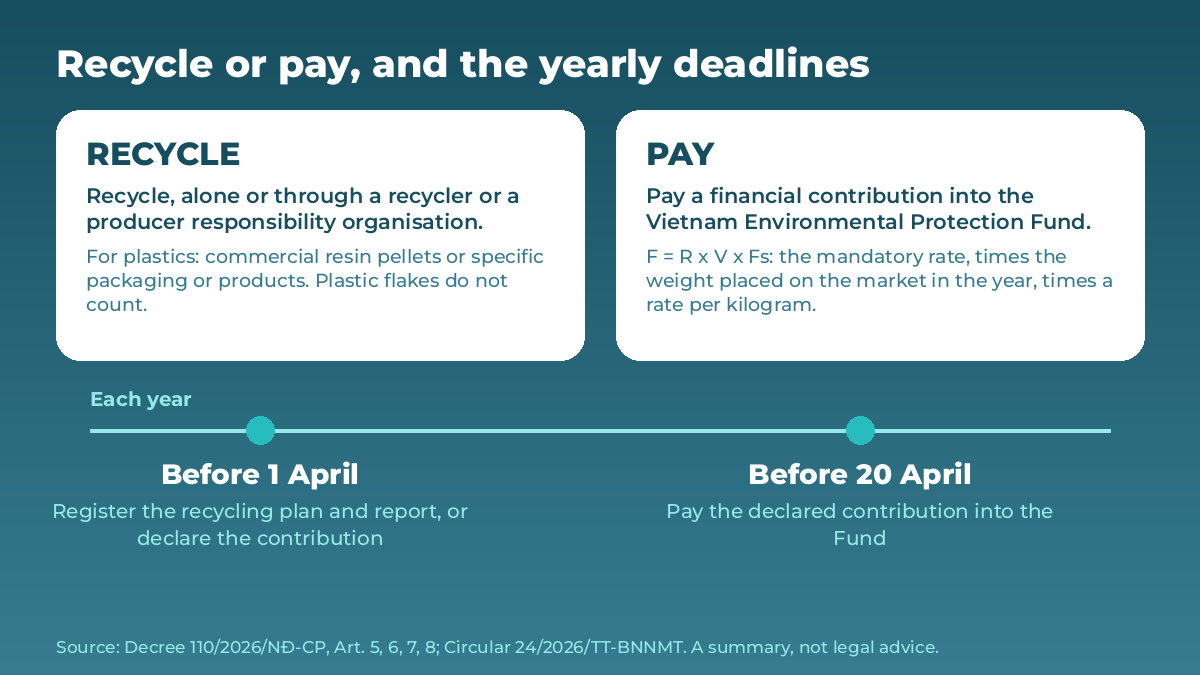
A producer or importer can recycle, alone or through a recycler or a producer responsibility organisation, or pay a financial contribution into the Vietnam Environmental Protection Fund. The contribution is F = R x V x Fs: the mandatory rate, times the weight placed on the market in the year, times a rate per kilogram set by the Minister of Agriculture and Environment.
Deadlines
- Before 1 April each year: register the recycling plan and report the previous year's results through the national EPR information system, or declare the contribution.
- Before 20 April each year: pay the declared contribution into the Vietnam Environmental Protection Fund.
- The same dates apply to the carrier-bag payment (Art. 10).
- Guidance and forms: Circular 24/2026/TT-BNNMT.
Where packaging choices help
Mono-material PE gives recyclers material they can turn into pellets, the specification the decree asks for. ReFlex, made with GRS-certified recycled PE, is a mono-material recyclable option. Lighter packs lower V, the weight in the formula.
For the recycling duty, the decree grants no general reduction for biodegradable or recycled-content packaging; one rigid plastic row in Appendix I excludes biodegradable plastic. The carrier-bag payment in Appendix II, item 6.8, covers non-biodegradable bags only.
Talk to us
Map your packaging against Appendix I with our team: info@turngreen.world
FAQ
When did Decree 110 take effect?
On 25 May 2026. It was issued on 1 April 2026.
Are retailers covered?
For the recycling duty, when they produce or import listed goods or are responsible for the label, for example on own-brand products. For the carrier-bag payment, when they import small non-biodegradable carrier bags or have them made under their own label or on contract (Art. 9(1)); otherwise the bag producer or importer pays.
What is the rate for flexible plastic packaging?
10%, for mono-material and multi-material flexible plastic packaging.
Can a company pay instead of recycling?
Yes. The contribution is F = R x V x Fs, declared before 1 April and paid before 20 April each year.
Does compostable or recycled packaging reduce the obligation?
For the recycling duty, there is no general reduction for either; one rigid plastic row excludes biodegradable plastic. The carrier-bag payment in Appendix II, item 6.8, applies only to non-biodegradable bags.
Are supermarket carrier bags covered by Decree 110?
Partly. The phase-out rules are in Decree 08/2022, Article 64. Carrier bags are not part of the Decree 110 recycling duty, but Appendix II, item 6.8 sets a waste-treatment payment, made by producers and importers, on non-biodegradable carrier bags smaller than 50 x 50 cm and thinner than 50 µm. Biodegradable bags are not in that item.